It's January the 17th and we are celebrating because, like most days, some things happened in the past that we should remember, if only for the laughs or the brief moments of pleasure we take in recalling these signal events. For instance:
1934: On the streets of downtown St. Paul, in broad daylight, banker Edward Bremer was kidnapped. He was stuffed in the back seat of a car, flanked by two burly hooligans. The kidnapping was successful in that the family of Mr. Bremer paid $200,000.00 to secure his freedom. A couple weeks later, Bremer was found wandering the streets of Rochester, Minnesota, a bit out of sorts but unharmed. He was able to provide enough information to the police that they fingered the Barker-Karpis Gang; an unholy alliance between Ma Barker, her sons, and one Alvin "Creepy" Karpis. In less than two years, police had captured or killed all of the alleged kidnappers. Bremer Banks prospered.
Fast forward 10 years. It's 1944. WWII is raging. In Paris, which would be liberated by the Allies that summer, Fancoise Hardy was born, She became one of the great French chanteuses. I am for some unknown reason fascinated by these breathy, slightly mysterious singers.
As a decided contrast to Ms. Hardy, we come to Steve Earle, born on this day in 1955. San Antonio, Texas, has produced many fine musicians and songwriters, Steve Earle is rugged and smooth at the same time. Like this:
Which brings us finally to 1980. Gareth McLearnan was born in Belfast. He's a flautist (pronounced "flootaste" in Ireland) and composer and conductor. Enjoy!
There's a tiny town in Indiana named South Whitley, which is odd because north of South Whitley there is no town named Whitley. South Whitley is due east of Fort Wayne and just north of Bippus. Another tiny town named Etna is nearby.
The only reason to mention South Whitley is that Janie Fricke was born there on this day in 1947. Ms. Fricke moved to Nashville and made some records.
She shares a birthday with the noted chanteuse Edith Piaf, born in Paris, France in 1915. Piaf was known as the Little Sparrow. She set the standard for a generation or two of French balladeers.
I think the title of this tune is "No, I'm not sorry."
Which brings us to a more contemporary event that happened on this day in 1998. Just before adjourning for Christmas break, the US House of Representatives passed two articles of impeachment against president Bill (Bubba) Clinton. They said he lied to congress and obstructed justice. The Senate later declined (somewhat shamelessly, in my view), to convict.
Here's another tune that fits the theme of today's blog post. Please enjoy...
Today (December 12) is the birthday of many well-known musicians and a few not quite so well-known. If you can spare about twenty minutes out of your busy day (and I suspect you can), please help me celebrate the birth of these folks.
We begin with two members of the Rat Pack -- Sammy Davis, Jr. and Frank "Ol' Blue Eyes" Sinatra. Sammy was born in Wilmington, NC in 1900. Little-known fact: he started his musical career as a drummer! Francis was born in 1915 in Hoboken, NJ.
Sammy and Frank were buddies and it is rumored that Frank intervened on Sammy's behalf with certain [ahem] influential folks in Vegas to open some doors there for Sammy.
Rumor has it that a guy named Musk plays "Fly me to the Moon" at every staff meeting.
Another New Jersey product born on this day (Newark, 1937) is Concetta Franconero, better known as Connie Francis. I'm reluctant to post a Connie Francis video because I really did not like her singing very much. But you might, so...
And we have to include Dickie Betts on our birthday list (Bradenton, FL 1948). Dickie is best know as a key member of the Allman Brothers band. Imagine playing guitar well enough to join Greg and Duane Allman!
It's 1957, Oakland, CA. Shiela Escovedo is born. She became a drummer and singer and songwriter and a good pal of Prince Rogers Nelson (aka Prince), who wrote this song. She helped bring funk to the masses and for that we should all be grateful
And finally, there's Eric Schenkman, born on this day in 1963 somewhere in Massachusetts. He co-founded the Spin Doctors, who wrote and recorded one of my favorite little ditties. Enjoy!
It's the birthday (1949) of Tom Waits. He was born in California, went to high school in Chula Vista, and describes himself as a "rebel against the rebels." This has been interpreted as a rebuke to the hippie culture in SoCal during his teens and a nod to the earlier beat generation -- the Kerouacs and Ferlinghettis and Brautigans. Waits is said to have been inspired by Bob Dylan and other early folk-rock figures.
Mr. Waits is a brilliant songwriter and dedicated individualist. I really like his stuff, especially the holiday classic "Christmas Card from a Hooker in Minneapolis."
Brautigan and Waits shared an affinity for the mundane and the absurd, as in this little gem from Brautigan:
Private Eye Lettuce
Three crates of Private Eye Lettuce,
the name and drawing of a detective
with magnifying glass on the sides
of the crates of lettuce,
form a great cross in man’s imagination
and his desire to name
the objects of this world.
I think I’ll call this place Golgotha
and have some salad for dinner.
--------
The Double-Bed Dream Gallows
Driving through
hot brushy country
in the late autumn,
I saw a hawk
crucified on a
barbed-wire fence.
I guess as a kind
of advertisement
to other hawks,
saying from the pages
of a leading women’s
magazine,
“She’s beautiful,
but burn all the maps
to your body.
I’m not here
of my own choosing.”
--------------
Thanks for stopping by and please enjoy some music and poetry of your own choosing.
On this day in 1921, John Bunch was born in Tipton, Indiana. Tipton is the county seat of Tipton County. It is roughly half way between Indianapolis and Kokomo. I don't think I've ever been to Tipton, but drove past it dozens of times. One of my old bosses worked at the mental health center in Kokomo. John Bunch was a pianist and formed the cleverly-named John Bunch Trio. They were on TV a few times and sold some records.
Here's Mr. Bunch and his pals.
This is a good excuse to dust off another classic about Kokomo
I have invited folks to comment on this blog and some of y'all have been generous enough to do so. But I am in a bit of a wrestling match with Blogger about comments. I want to respond to comments with clever or snarky or supportive ripostes, but I can't seem to comment on my own blog, much less respond to comments left by others. This is strange and frustrating (at least to me). Blogger's help feature has been no help at all. So...do not misinterpret my lack of response to your comments: I do read and enjoy them!
On this day in 1931 Shintaro Katsu was born in Fukagawa, a suburb of Tokyo known for its geishas. He
grew up to become an actor, singer, producer, and director. He directed the
seminal martial arts movie "Zatoichi Meets the One-Armed Swordsman."
I've never been to Japan, but the titular focus of this old blog, Richard
Brautigan, spent a year there (1975/76), which culminated in his poetry
collection "June 30th, June 30th." Here is a short poem from the book, in
which Brautigan remembers the feeling of never fitting in, never being
entirely comfortable -- except perhaps at the game arcade!
Pachinko Samurai
I feel wonderful, exhilarated, child-like,
perfect.
I just won a can of crab meat*
and a locomotive**
What more could anyone ask on May 18,
1976 in Tokyo?
I played a game of pachinko
/ vertical pinball /
My blade was sharp.
*real
**toy
The only person in my immediate family to have been in Japan (so far as I know) is my father. He flew several missions from Okinawa to the main islands of Japan in the late stages of WWII, including some transfers of Japanese POWs just after Japan surrendered. In our back hall closet hangs a silk embroidered smoking jacket he got in Japan. One of my sisters has the Samurai sword he brought back.
Fukagawa was also where the esteemed Haiku master Basho lived for a time. Here's a Basho poem, translated, curiously enough, by Robert Hass.
On this day in 1899, one Howard Hoaglund Carmichael was born in Bloomington, Indiana. Carmichael, known to everyone as Hoagy, was a great songwriter, credited with many contributions to what some still call the Great American Songbook.
I lived a couple blocks off campus in Bloomington, and there was a little diner nearby called The Gables. I ate lunch there often because they offered students a punch card deal -- twelve meals for the price of ten, or something like that. Their beef commercial was cheap and filling.
In the back at The Gables stood an old upright piano with a small plaque commemorating the fact that Carmichael wrote many of his hits there, when the building was a bar. Here's Diana Krall crooning a Carmicheal tune. Enjoy!
In a recent TV news story, the reporter referred to “The University of Indiana.” As you surely know, the official name of the school (my alma mater) is Indiana University. There is a school called Indiana State University in Terre Haute (French for ‘high ground’ even though it’s really not very). There is also a school called Indiana University of Pennsylvania because it is in the city of Indiana, Pennsylvania. So far as I know, only one major university has officially tacked “The” in front of its name:
The Ohio State University, although the official name of Rutgers includes an emphatically capitalized 'the':
Rutgers, The State University of New Jersey. But there are a half dozen other state universities or colleges in New Jersey.
I worked at The Ohio State University when the name and logo were changed, which lead to no perceptible difference on campus. Coincidentally, I lived on Indianola Avenue in Columbus. There’s another school in Ohio called Ohio University. It’s in Athens, OH. I think the founders of Athens had unrealistic aspirations.
I did a stint as a student teacher in Columbus, Indiana. Columbus, IN, billed itself as the Athens of the Prairie not in homage to Athens, Ohio, but because Columbus, like the Original Athens, boasts many fine buildings designed by famous architects. The famously high architecture fees were paid for by the founder of the Cummins Engine Company because he liked nice buildings. My student teaching gig, which did not go well, was at a school designed by famous architect Eliot Noyes,
who apparently knew little about schools but a lot about poured concrete.
I worked for a time in the architecture department at the University of Illinois in Urbana-Champaign, two cities named for a city and county in Ohio. The founders were not very imaginative. The main campus library is underground. Even the architects I worked with at U of I did not know why.
So be careful when people talk about Indiana or Columbus or Athens or Urbana or Champaign or any school associated therewith; you might want to get some clarification.
We don’t speak or read Hungarian, but that didn’t stop us (though maybe it should have) from setting out to explore Budapest on our own. No guide, no guidebook, just a map from the hotel front desk.
It’s what we often do when travelling – just go! We like to have a bit of serendipity, even though that approach sometimes doesn’t work out. We like to use local public transportation if possible because it gives a more authentic feel for the layout and the rhythms of the city. And the people are usually friendly, though they can easily spot us as tourists: we’re the ones looking at the signs and then at the map and then at the signs again, pointing first one way and then the other, obviously lost or nearly so.
The trip started in Prague and ended in Budapest. On our first day in Prague, we set out with another couple who wanted to see the famous “dancing house” designed by Frank Gehry. We went to the subway station, looked at the map on the wall and jumped on the red line, intending to transfer to the yellow line. After getting off at the transfer station, one of us said that we’d made a mistake and we really should have gone in the opposite direction. So we ran to the other side of the station, got back on the train and returned to our starting point. Then we realized that the original plan had been the correct one. We eventually made it to the Dancing House, took pictures, and went in search of some Czech beer, which we eventually found off a pleasant path by the Vltava River (Smetana called it by its German name, the Moldau). Later, we learned that there’s a nice bar on the top floor of the Dancing House.
The subways in Prague and Vienna and Budapest all used roughly the same fare process: Go to a kiosk and buy a ticket, then scan or stamp the ticket at a little box as you enter the platform (see the orange box on the post in this photo.)
No turnstiles, nobody patrolling or asking to see your tickets. We obediently bought our tickets each day or each trip, and we noticed that (a) most riders had passes so they didn’t mess with paper tickets and (b) those with paper tickets never stuck them in the slot. Everyone just walked on and off and the poor validation boxes got totally ignored.
We still bought tickets, not wanting to be freeloaders, but after many trips over several days in all three cities, we no longer bothered to stick the little tickets in the little slots.
On the last day of the trip, we headed out to find the market in Budapest. It was nice. We ate on the patio of a small restaurant near the market. It was very nice. Map and tickets in hand, we figured out the best route back to the hotel and hopped on the subway again.
The exit we chose was monitored by three burly uniformed gendarmes, checking tickets. We happily presented our tickets, purchased less than two hours before. The official was not pleased. We expressed our puzzlement through confused expressions and frantic pointing at the tickets. He made it clear through gestures and scowls that we had failed to validate the tickets. We countered by saying ‘well, yes, but we do indeed have tickets, and besides nobody else seems to be validating them.’ This was unconvincing. He pulled us aside and made it clear that we couldn’t leave until we paid a fine. We didn’t have enough Forints [I don’t know how one could ever have enough Forints because it takes 2,600 of them to equal 1 US dollar] but the official was happy to accept a credit card on the spot.
The ride cost us about $40.00. Up the stairs to street level to discover that we’d gotten off one stop too soon.
“The county, which owns the 88-acre property housing The Ponds at Battle Creek golf course, has been working with the city of Maplewood to reconfigure the property. Citing poor earnings, the county had planned to close The Ponds in December. When the community pushed back, the county agreed to delay the closure…" --- St. Paul Pioneer Press, March 2, 2021
Who exactly pushed back? The neighbors? The city council of Maplewood? Golfers? The cast of "Caddyshack"?
“What does your organization do for the greater community?” -- Karla Hult, reporter for KARE11 TV, interviewing someone from a drug treatment program about support for graduates.
In the same story, one of the graduates referred to “the recovery community.”
I suppose the greater community is a very large area which may include the recovery community, which I suppose includes people recovering from addiction and their families and their friends and their employers and coworkers and neighbors and the cops who busted them and… Once again, the term is so broad and so vague that it has almost no meaning.
“…to be connected to a local agent in your community.” --- Part of an ad for health insurance (Aetna).
Where else would a local agent be?
“As chef Jack Riebel -- co-owner of The Lexington -- prepares to undergo an aggressive fourth treatment for neuroendocrine cancer, the Twin Cities community is rallying around him.” --- from Pioneer Press web site March 8, 2021.
We’re all pulling for Mr. Riebel, but only in “the Twin Cities community?” What about the suburbs?
“A neighborhood advocacy group is seeking community members interested in planning a downtown St. Paul park.” -- Pioneer Press web summary March 17, 2021
Isn’t a neighborhood advocacy group already composed of community members? How about ‘residents’ or ‘people’?
“Thank you for the honor of representing our communities in the state legislature.” --- Opening sentence on a postcard from our state representative.
I don’t know which communities he’s talking about. He represents a legislative district, so presumably he’s talking about all the communities in the district, so he should simply say “our district.”
“TPT 2020 Annual Report to the Community.” --- Title of the annual report by Twin Cities Public Television.
Why not just call it the annual report?
“Benjamin Moore is committed to community at this time.” --- Banner near the top of the main page at Benjamin Moore paints web site.
I don’t even know what to say to this bit of corporate balderdash.
“Thanks for your participation in the Fine Arts at our community’s public schools.” – In a letter from the Northfield Fine Arts Boosters.
Just say “our public schools” because we already know that those schools are in our community.
++++
If you feel tempted to use the word “community”’ please pause and consider something more concrete or specific. Customers. The city. The school district. Employees. Constituents. Voters. Members. Think hard about who you’re actually talking about or talking to. Just because the word feels kind of cozy and friendly and do-gooderish, “community” is really amorphous and ambiguous. That is my message to the writing community.
While you ponder this, please enjoy a somewhat related video from the distant past. You might become a reluctant member of the nostalgia community.
Just after we were married, Kathy and I bought a house in south Minneapolis. All
three of our children were born while we lived there. We spent a lot of time
fixing up that house. It was a very well-built Tudor-style stucco house, of
which there are hundreds in that part of town. It had a heavy wooden arched
front door that I refinished. The door had a small plain window. My dad made a
lovely stained-glass window to replace the plain one. I watched him carefully
install that window.
About six years later, we sold the house. We debated taking
the window out but I was afraid I might damage the window or the door, so we
left it there. That was 35 years ago. This year, for my 75th birthday, our
daughter Karin gave me that window!
She had recalled me lamenting (probably more
than once) about leaving the window behind. So she found out who owns the house
and talked them into swapping the old stained-glass window for a new one. They
were very nice about it, allowing someone Karin chose to carefully remove the
window and design a replacement that they could call their own.
The gift was
completely unexpected and I still smile each time I recall that evening. Such a
kind and thoughtful gesture!
I took the window to a local frame shop and they
made a very nice cherry wood frame. The framed window now hangs in the large
front window of our house and when we move, this time it’s coming with us!
I quit Twitter today. Didn't even bother to alert my very few followers. This is part of an effort (futile, no doubt) to take a step away from the oligarchs and whackos who seem to dominate what is inaccurately called "social media." One way to ensure that the censors or flamethrowers or shade throwers aren't surrounding or diostorting or silencing is to be my own damn content moderator. So...it's back to blogging. Gradually, folks that I know and like will be able to see these musings and maybe even enjoy them.
Looking back on postings from a few years ago, I realized that it was fun to talk a little about travels and travails. We're going on a couple of short trips to warmer climates this year, so look for edifying dispatches from the great southwest desert or the southeast coast.
Exciting, no?
The title of this post is a bit of an exaggeration, even though there were a few annoyances on our trip from Livorno to Pisa and back. Let's get those out of the way quickly:
1. We wanted to go to Lucca but the driver said there wasn't time. (He was probably right.)
2. There was a brief but very hard rainstorm while we were in the very striking archeological museum in Pisa, which would have been OK except that hordes of tourists took refuge in the museum lobby and we had to elbow our way out.
3. After returning from Pisa, we were having a nice lunch in Livorno when we were importuned by a panhandler who was polite at first but grew increasingly aggressive. It was annoying but the staff seemed not to care. We encountered the same fellow an hour later while we waited for the bus.
Ah, well, these things happen. We still enjoyed our brief visit. Some highlights:
Yes, the famous tower still leans and still attracts people who insist on posing as if they are (a) preventing it from falling or (b) pushing it over or (c) about to be crushed by it. It was kind of fun watching them jockey for position. We chose to go into the cathedral and the adjacent baptistry, which are worth a visit even without the draw of the leaning tower. The ceiling of the cathedral is spectacular.
The covered market in Livorno was an unexpected pleasure. Marco, the driver, dropped us off there to kill some time while he made a few contacts to find someplace to get pizza for lunch. The problem is that most restaurants don't serve pizza until much later. The locals don't eat pizza for lunch and it takes a few hours just to get the wood-fired or coal-fired ovens up to cooking temperature. That's OK. Anyway, the market was lively and fun and we bought some treats to take home.
We did eat lunch on the patio of a nice restaurant called Quattro Mori , named for a monument that stands across the street. The monument shows four African men in chains and a member of the Medici family freeing them. It commemorates the declaration by the ruling Medicis that slavery would be banned. The Tuscans are justly proud of that heritage.
Leonard Franklin Slye was born in Ohio on this date in 1911. He took up horse riding and guitar playing and an assumed name -- Roy Rogers -- and enjoyed some success way out there in Hollywood. He married a talented cowgirl named Dale Evans. There is a little town in Iowa named Evansdale. There really should be a town nearby called Rogersroy. Anyway, here's a different Roy Rogers playing a different guitar.
Elba is part of Italy -- officially a Tuscan outpost -- though it's easy to get confused because its most famous occupant was (more or less) French and because it's pretty close to the Balearic Islands, which are Spanish.
The main city is Portoferraio. It, like the rest of Tuscany, was once ruled by the Medici family. The juxtaposition of Medici and Bonaparte is a fascinating element of Elba's culture. We had fun in Portoferraio -- once again getting off the boat with no real plan.
A block from the port entrance, we encountered Oscar, who had a cute three-wheeled jitney (sometimes called an auto rickshaw) and offered to drive us up the steep narrow streets to the big forts (one built by the Medici dynasty), then back down through town. For 24 Euros, and to avoid having to climb all the way, we took him up on his offer.
That was a very cool ride! Oscar, whose command of English was limited, zipped around the switchback turns and, whenever we came to a spot with a nice view, would screech to a stop, point, and say "picture!"
Here are a couple of those pictures -->
Oscar knew the staff at the old fort, so they let him take us into a few places not normally open to tourists, including a narrow corridor inside the walls where archers would fire arrows down onto invading armies. Oscar pointed to a set of wooden doors at the end of the hallway: "Five hundred years old!" he said proudly. Oscar also advised us to buy a day pass -- a ticket that would allow us into various buildings and galleries maintained by the historical society. We did, and it proved to be a good deal.
After poking around the fort/castle, Oscar took us to the house where Napoleon lived, past a theater that Napoleon built, and to a nearby chapel dedicated to Napoleon.
He pointed at the small dome above the altar and had me use the cell
phone camera to zoom in on the very top of the dome, where there is a
small pyramid with an eye looking out of it. "Just like US dollar bill!"
said Oscar. He couldn't explain the coincidence and neither can I.
Oscar took us back down through town to the waterfront, where we ended his tour and began the hunt for lunch. We had been advised by the nice ladies at the fort to go to the Piazza della Repubblica. Almost every Italian town has a Piazza della Repubblica, usually a lovely town square with monuments and churches and shops and restaurants and pigeons.
We found the square easily but it had been entirely given over to cars. The piazza was a damn parking lot! Well...
We knew of a restaurant next to the theater, having done a little research before our visit. It's called Teatro (check the web site here) and has a nice patio with a view over a small park, the sparkling sea in the distance. We found it easily (having zipped past with Oscar) and had a very nice lunch, including of course the local beer.
On the menu at Teatro, the owners are listed as Antonio and Fiona de Medici!
The day pass got us into the theater, which Napoleon ordered built
inside a church. Several tiers of luxury box seats were sold to rich
Elbans and Napoleon used the proceeds to finance his escape. The theater
is still in use.
The obligatory visit to an
archeological museum and shopping at a couple of nice pastry shops
rounded out our visit. Fun and educational day!
This was, unexpectedly, a highlight of our trip along the coast.
Hyeres: From the port of Le Lavandou, we took a bus ride to this medieval village, passing through Bormes-Les-Mimosas on the way. Both are known for their flowers, although this is also wine and olive country. Hyeres is lovely, with its ancient ramparts and narrow streets and flowers.
One of my pet peeves is the use of fake shutters on modern buildings in a failed attempt to give them character. Here, of course, the shutters are very real and very practical and, almost always, very charming. I took a close-up photo of a window in an old house -- planning to use the picture in a forthcoming magnum opus (read: rant) about fake shutters. As soon as I had snapped the picture, an old gentleman leaned out the window and yelled at me. I apologized, or tried to, using my very poor French. In spite of his protests, I'm still going to use that photo in the forthcoming shutter screed. You've been warned.
Wandering narrow cobbled streets never gets old. In Hyeres, the views were stunning, looking out over groves of olive trees to the glittering sea.
The lanes, as advertised, are lined with flowers, blooming even in late October.
Of course, Hyeres boasts a town square with an old church and nice restaurants. I don't know quite what it is about these places, but I feel very peaceful (and a little snobbish), pretending vainly to act like a local, just hangin' out.
Domaine de l'Anglade: From Hyeres, we went back through Bormes-les-Mimosas to the outskirts of Le Lavandou and stopped at a small winery. A brief tour and a short presentation about winemaking and the history of this winery, then into the tasting room. Kathy's California cousins, because they are Californians, are wine experts. They pronounced the white wine very good (even ordering a few cases shipped back to California), the rose very good, and the red just so-so. I enjoyed the toast with tepanade (well, yes, and the wine, too.)
The winery was founded as a hobby by a family that had made its fortune in the reed business: reeds for clarinets, bassoons, oboes, saxophones, and English horns. The plants from which the reeds are made grow well in this microclimate. Vandoren reeds (sold exclusively from their Paris outlet) are, we were told, famous.
The hillside setting and the friends and the wine and the lovely weather -- such a pleasant afternoon!
Le Lavandou: Back to Le Lavandou and a stroll through the busy waterfront district. It's a warm Saturday and the place is busy but not crowded.
Sttraying a little from our usual practice of eating lunch in a small outdoor restaurant. We got street food instead -- a very nice big crepe with some kind of chocolatey fruity filling, from a one-man stand next to some boules courts (like bocce except the French use steel balls).
The pedestrian walkway was a delight because someone had constructed a half-dozen interactive sculptures which also served as games, made from reclaimed lumber, tree limbs, springs, string, tennis balls -- all kinds of clever and cool stuff.
The coolest was a contraption that had a long metal arm balanced on a stack of old books. On one end of the arm a full-sized upright piano was suspended. On the other end, a platform with a red plush carpet on it. The operator would seat four or five people on the carpet, crank up the machinery to make the whole thing rotate, then climb onto the piano bench and play sprightly music as the magic carpet made slow circles. I took a video but I'll be damned if I can find it now. The still photo here doesn't do it justice.
Everybody was smiling and taking photos. Pretty neat!
I'd heard of Cannes and Marseille and Toulon and San Tropez -- famous places on France's Mediterranean coast where rich people go to play in the summer. But I had never heard of Sete or Le Lavandou. When we decided to join Kathy's California cousins on this trip, these two places were intriguing precisely for this reason.
From Menorca, Spain, we sailed the short distance to Sete, France. Pronounced "set" (emphasis on the only syllable), it's a quiet port known for its fishing, its canals (billing itself the Venice of France is a bit of promotional hyperbole), and its oysters.
Our plan, after doing some superficial research, was to go the market (Les Halles de Sete), buy some fresh produce and bread and cheese and pastries and have ourselves a picnic. It almost worked!
Using a fairly detailed map, we walked to where the market should have been but found instead a clothing store fronted by a small plaza where some musicians were playing. That was nice. We figured we'd misread the map so walked around in ever-widening circles until we had given up.
During the stroll, when our heads weren't buried in the map, we saw some cool murals, which the guidebook failed to mention. This is Kathy in front of one mural, looking intently (again) at the map.
Back to the square (square one?). The market really should be right here! On a hunch (and driven by hunger) we walked through the clothing store and, sure enough, the huge indoor market was there, filled with fish and bread and cheese and pastries and a couple of tiny bars and meats and lots of people. I mean LOTS of people. We abandoned the picnic plan, a decision I now regret (especially after having visited the web site of Les Halles de Sete) but at the time we were intimidated by the crowds and the noise.
Instead, we sat at a nice bakery next to a park and had some pastries, which would hold us until we could track down a real lunch.
Our second idea was a canal boat tour. Some of our traveling companions had booked one through the cruise line, but we are stubbornly independent and cheap, so we figured we'd find one ourselves. And...we did!
A local company called Sete Croisiers runs three canal tours. BUT..the ticket offices were closed for siesta, so we had to wait, which was fine, so long as we could get some FOOD. Across the street from the shuttered ticket booth was a restaurant called, incongruously, the Hippie Bar, with its own bizarre mural (see below).
I ordered oysters (the famed local delicacy) and tried to order beer, but somehow the server and I failed to communicate, so I ordered a glass of white wine instead. The oysters were very good, with a kind of raspberry vinaigrette for dipping. The wine never came. Hey, we're in France, for heaven's sake! No wine? Merde...
Anyway, after lunch we got on the canal boat. The tour was inexpensive and interesting. We saw a bunch of oyster beds in the bay, some cleverly engineered drawbridges, lift bridges, and bridges that pivoted.
The narrator, who looked like Jean-Paul Belmondo, spoke only French, but we followed along with an English illustrated brochure, and that worked OK. Each time we went under a low bridge (so low we really did have to duck), Jean-Paul would lean into the microphone and genially use the only English phrase he was sure of: "Oh my God!"
Despite the lack of wine at lunch and the market that was strangely hidden from view, we liked Sete because it was kind of funky and unpretentious and accessible.
The medium-sized cruise ship took us overnight from Mallorca to the neighbor island of Menorca. Menorca, as its name implies, is the smaller of the two. When it comes to islands in the Mediterranean, small is good!
From the port of Mahon (sometimes spelled Mao) we took a drive around the island. First stop, the tiny resort town of Fornell (pronounced FourNAY).
It's the last week of October. The weather is fine -- sunny and warm. But the resorts around Fornell are almost all closed for the season. The town is quite pretty; the bay reminded me of La Jolla (except no seals or whales). We sat at an outdoor bistro (S'Algret) on the small town square (Placa S'Algret), had a snack, and enjoyed the view.
From Fornell, we drove into the hills to the center of the island, dubbed Monte Toro (in Catalan, "toro" is derived from a word that means "high"[and that's no bull]) where centuries ago the Crusaders built a fort and a chapel, which later became a nunnery. I think the large gift shop is a fairly recent addition. From the top, you can see the entire island and, on a clear day, the peaks of Mallorca in the distance. It's pretty.
At the top of the hill, the Catholics built a big statue of Jesus, arms outstretched. The founders didn't count on cell towers spoiling the view.
Back down the mountain to Mahon, where we wandered the streets. Many shops were selling sandals made of cork and recycled automobile tires. Apparently this is a thing on Menorca. We resisted the urge to buy sandals.
There were lots of stores selling gin distilled on the island. The locals are proud of their gin. We didn't buy any, but...there was a very neat little toy store, so the grand-kids benefited from this visit!
Pursuing our goal of dining al fresco at local restaurants whenever possible, we found a bistro -- Ristorante Santa Rita -- on a small square across from a church (of course).
A leisurely lunch of tapas and the local beer (Cerveca Alhambra) and a sunny mid-day -- nice combo. We had the albondigas (which was nothing like the Mexican soup of the same name) and something else. The restaurant was near the top of these steps, which we walked down on the way back to the port. Someone said there are 150 steps -- I counted 115.
After the unexpectedly busy port city of Palma, the size and pace of Mahon was very pleasant indeed.
From Barcelona, we went to two islands in the Mediterranean (or in these parts often called the Balearic Sea): Majorca (sometimes spelled Mallorca) and Menorca (sometimes spelled Minorca). I think the names mean Big and Little (sometimes spelled Major and Minor).
On Majorca, the port city of Palma was larger and busier than we anticipated (yes, we probably should have studied it a bit more in advance). We wanted to see the interior of the cathedral in Palma because Mr. Gaudi had redesigned it.
Turns out there's a fairly stiff admission fee and we balked at that, plus the line seemed long at the gate. Also, we had pretty much decided to take a vintage narrow-gauge train from Palma to a smaller artsy village called Soller, a side trip that would take most of the day.
Across from the cathedral was a tourist information office, where we got a map and directions to the train station. We aren't very good at following maps or directions, I guess, because it took us a while to find the train station.
According to some guidebooks and travel web sites, the ride to Soller is spectacular, up mountains and through valleys with lovely views. The train schedule even included a stop about half way just for pictures. Once we passed the industrial outskirts of Palma, it was a very pleasant ride. Not spectacular, but that's OK.
Soller had several surprises. The train station had two art galleries, one featuring a bunch of Picasso's ceramic work (including this scary vase shown bekow); the other with Miro prints. Spectacular!
The center of Soller was, of course, a busy public square (Plaza Constitucion) with, of course, a big church. We found an excellent restaurant on the square (Cafe Central) and had lunch, accompanied by White Rose, a fine local lager.
Soller is charming -- narrow winding cobbled lanes always seem charming -- even though it's mostly dedicated to shopping. Some touristy junk, but also some cute local shops. We looked at the Estudio de Grabados Llunatic Creusa, a one-man printmaking operation run by Ricardo Fontales. Sadly, the shop was closed. Happily, Ricardo is a blogger, too: http://ricardofontales.blogspot.com.
One of the highlights: We got back to Palma kind of late, so instead of wandering through town back to the cruise terminal, we hailed a taxi from the train station. The driver asked us where we were from and when we said Minnesota, he immediately responded, "Oh! Bob Dylan!" So we sang some of the Dylan tune that includes references to boots of Spanish leather. Smiles all around, and we just made it back to the ship in time.
We really should have taken the afternoon to rest and
recover from jet lag. But we instead went with our rag-tag traveling party of
10 to one of the many markets in Barcelona (the Mercat de Galvany, built in
1868). There we met our guide/cook and her daughter, who bought wine and the
makings of paella, apparently the national dish of Cataluña. We watched a
fishmonger cut up an octopus; bought fresh tomatoes and crusty bread to make
the Catalan version of bruschetta, and looked longingly at some pastries.
From the market, we walked a block to a third-floor
apartment (apparently belonging to a friend of our guide). There we were
treated to a fine home-cooked meal. The guide and her daughter explained each
dish, with a particular focus on paella – each ingredient and each step of the
cooking process. We had homemade tapenade on toast and the guide showed us how
to use the sliced fresh tomatoes by scraping the cut side across a piece of
toast and then pouring a bit of olive oil on it.She claimed that the olive oils in Spain are superior to any
other olive oil and accused Italians of buying Spanish olive oil and
repackaging it as Italian oil. We indulged this heresy because we didn’t want
to be rude and we were soooooo tired and, heck, maybe she was right!
Our guide and her daughter regaled us with their take on the
recent demonstrations in Barcelona over the independence of Cataluña. They
stressed that the language, cultures, and history of the region are so distinct
that it really never should have been a part of Spain, and that the Spanish
government is corrupt and takes far more from Cataluña than it gives back. They
also said the Western press had been unfair to the independence movement –
indeed, she used the phrase “fake news” to describe the reports in US news
outlets.
During this discussion, our guides strongly hinted that they
thought our president a buffoon and maybe even a dangerous one. We were quick
to tell them that we held the same dim view of the man.
Those of us who had arrived that morning began to nod off,
so we adjourned with hugs. The paella was good, the wine (Vina Esmeralda) was
good. We had learned that the paella is ready when the pot bubbles slowly,
making a “choop choop’ sound (which they spell xup xup.) Our guide led us in a
chorus of “xup xups” as we left.
We took a taxi to our hotel, a few blocks from the Placa de Cataluña
and just a block off the famous Las Ramblas (or La Rambla) pedestrian mall. We
crashed, sleeping a few hours, waking up in the dark, not really knowing what
time it was. We finally stumbled from bed and walked to a very nice little
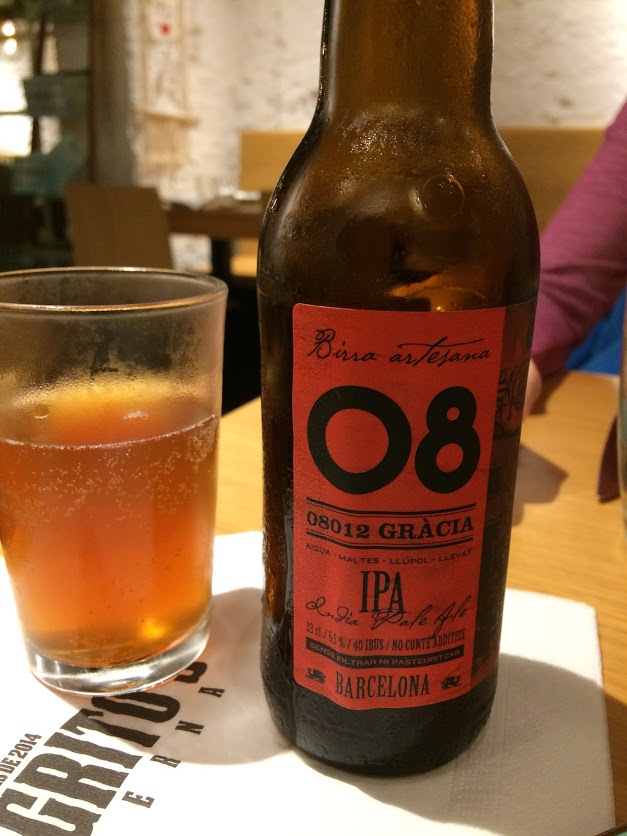
tapas bar – Taberna Mil Gritos (“a thousand cheers” or “a thousand screams” –
probably the former). The excellent local IPA was a nice surprise.
Our tiny hotel served a generous breakfast,
after which we walked to Placa de Cataluña and got on the Hop on/Hop off bus.
We rode around for a while, getting off at the justly famous Sagrada Familia
church, Gaudi’s architectural masterpiece. We’d been advised to buy tickets in
advance for this popular attraction but of course we hadn’t. Turns out we could
get tickets for that afternoon, so we did.
Back on the bus, we rode around through the city, not really
sure where we wanted to hop off. I wanted to see another Gaudi creation, the
Parc Guell, but we couldn’t find it even though the bus supposedly stopped
there. Turns out the park is a few blocks from the bus stop, which we would
have learned had we but asked the attendant. Missed opportunity for sure!
We hopped off the bus before it completed its circle and
started walking more or less in the direction of Sagrada Familia. We stopped
for lunch at a nice corner café. I looked for the bathroom but the only door I
could find was labeled “Servicia” which I assumed meant a service door (you
know, like for staff or deliveries). So I asked and the nice counter person
pointed to the Servicia door, which did indeed lead to the bathrooms. I really
should have studied that Spanish phrase book more closely.
We walked to the Sagrada Familia after lunch, found the
entrance for ticketed guests, and got in line. A minute before entering, a
nasty storm – wind and rain and lightning – descended. We had brought an
umbrella, so, unlike many hundreds of other visitors, we stayed more or less
dry.The church is spectacular!
The self-guided audio tour, using a very clever little wireless device, was a
bit hard to follow, but it was very informative nonetheless. We learned many
things one would not learn just by wandering around gawking, although the place
is definitely gawk-worthy. The esteemed Mr. Gaudi is buried there and the
construction crews are still at work.
I was struck by the attention to detail in every aspect of
the design. Gaudi was obsessive, sketching every piece of furniture and every
pane in the soaring stained glass windows. The massive tapered columns that
hold up the roof are just one example: Each pair is a slightly different color
of stone and each column gets lighter as it rises; each pair is fluted in a
slightly different way. These subtleties are almost lost in the grandeur of the
whole – we had to look carefully at things right in front of us at the same
time trying to take in the sheer scale of the place.
By the time our visit was over, the storm had passed and the
sun was out!
We decided to get on a different Hop on/Hop off bus route,
but got lost trying to find it. This is one of the downsides of do-it-yourself
travel planning: sometimes you miss stuff, you take a wrong turn, you think
you’re wasting time. But we definitely enjoyed our first day and a half in
Barcelona.
The next day we used up our Hop on/Hop off tickets,
intending to stop and take the cable car from the port up to Montserrat (or was
in Montjuic?). But… cable car not running, too windy. We intended to stop at
the Miro museum (Fundacio Joan Miro), but….too late, not open. We made a long
loop around the city and decided to hop off near the waterfront and walk part
way back to the hotel via La Rambla. This worked except for the fact that
the route was blocked by demonstrators, meaning we couldn’t hop back on where
we wanted to.
But the walk, though longer than planned, was quite
pleasant. We found another pedestrian street just a block or two from La Rambla
that was delightful and took us past the Cathedral of the Holy Cross, where there was a classical music group
giving a concert on the steps.
I do enjoy these serendipitous happenings! And we still made
it back to the hotel in time to pack up, check out, and get a taxi to meet our
traveling companions for the next leg of the trip.