The medium-sized cruise ship took us overnight from Mallorca to the neighbor island of Menorca. Menorca, as its name implies, is the smaller of the two. When it comes to islands in the Mediterranean, small is good!
From the port of Mahon (sometimes spelled Mao) we took a drive around the island. First stop, the tiny resort town of Fornell (pronounced FourNAY).
It's the last week of October. The weather is fine -- sunny and warm. But the resorts around Fornell are almost all closed for the season. The town is quite pretty; the bay reminded me of La Jolla (except no seals or whales). We sat at an outdoor bistro (S'Algret) on the small town square (Placa S'Algret), had a snack, and enjoyed the view.
From Fornell, we drove into the hills to the center of the island, dubbed Monte Toro (in Catalan, "toro" is derived from a word that means "high"[and that's no bull]) where centuries ago the Crusaders built a fort and a chapel, which later became a nunnery. I think the large gift shop is a fairly recent addition. From the top, you can see the entire island and, on a clear day, the peaks of Mallorca in the distance. It's pretty.
At the top of the hill, the Catholics built a big statue of Jesus, arms outstretched. The founders didn't count on cell towers spoiling the view.
Back down the mountain to Mahon, where we wandered the streets. Many shops were selling sandals made of cork and recycled automobile tires. Apparently this is a thing on Menorca. We resisted the urge to buy sandals.
There were lots of stores selling gin distilled on the island. The locals are proud of their gin. We didn't buy any, but...there was a very neat little toy store, so the grand-kids benefited from this visit!
Pursuing our goal of dining al fresco at local restaurants whenever possible, we found a bistro -- Ristorante Santa Rita -- on a small square across from a church (of course).
A leisurely lunch of tapas and the local beer (Cerveca Alhambra) and a sunny mid-day -- nice combo. We had the albondigas (which was nothing like the Mexican soup of the same name) and something else. The restaurant was near the top of these steps, which we walked down on the way back to the port. Someone said there are 150 steps -- I counted 115.
After the unexpectedly busy port city of Palma, the size and pace of Mahon was very pleasant indeed.
From Barcelona, we went to two islands in the Mediterranean (or in these parts often called the Balearic Sea): Majorca (sometimes spelled Mallorca) and Menorca (sometimes spelled Minorca). I think the names mean Big and Little (sometimes spelled Major and Minor).
On Majorca, the port city of Palma was larger and busier than we anticipated (yes, we probably should have studied it a bit more in advance). We wanted to see the interior of the cathedral in Palma because Mr. Gaudi had redesigned it.
Turns out there's a fairly stiff admission fee and we balked at that, plus the line seemed long at the gate. Also, we had pretty much decided to take a vintage narrow-gauge train from Palma to a smaller artsy village called Soller, a side trip that would take most of the day.
Across from the cathedral was a tourist information office, where we got a map and directions to the train station. We aren't very good at following maps or directions, I guess, because it took us a while to find the train station.
According to some guidebooks and travel web sites, the ride to Soller is spectacular, up mountains and through valleys with lovely views. The train schedule even included a stop about half way just for pictures. Once we passed the industrial outskirts of Palma, it was a very pleasant ride. Not spectacular, but that's OK.
Soller had several surprises. The train station had two art galleries, one featuring a bunch of Picasso's ceramic work (including this scary vase shown bekow); the other with Miro prints. Spectacular!
The center of Soller was, of course, a busy public square (Plaza Constitucion) with, of course, a big church. We found an excellent restaurant on the square (Cafe Central) and had lunch, accompanied by White Rose, a fine local lager.
Soller is charming -- narrow winding cobbled lanes always seem charming -- even though it's mostly dedicated to shopping. Some touristy junk, but also some cute local shops. We looked at the Estudio de Grabados Llunatic Creusa, a one-man printmaking operation run by Ricardo Fontales. Sadly, the shop was closed. Happily, Ricardo is a blogger, too: http://ricardofontales.blogspot.com.
One of the highlights: We got back to Palma kind of late, so instead of wandering through town back to the cruise terminal, we hailed a taxi from the train station. The driver asked us where we were from and when we said Minnesota, he immediately responded, "Oh! Bob Dylan!" So we sang some of the Dylan tune that includes references to boots of Spanish leather. Smiles all around, and we just made it back to the ship in time.
We really should have taken the afternoon to rest and
recover from jet lag. But we instead went with our rag-tag traveling party of
10 to one of the many markets in Barcelona (the Mercat de Galvany, built in
1868). There we met our guide/cook and her daughter, who bought wine and the
makings of paella, apparently the national dish of Cataluña. We watched a
fishmonger cut up an octopus; bought fresh tomatoes and crusty bread to make
the Catalan version of bruschetta, and looked longingly at some pastries.
From the market, we walked a block to a third-floor
apartment (apparently belonging to a friend of our guide). There we were
treated to a fine home-cooked meal. The guide and her daughter explained each
dish, with a particular focus on paella – each ingredient and each step of the
cooking process. We had homemade tapenade on toast and the guide showed us how
to use the sliced fresh tomatoes by scraping the cut side across a piece of
toast and then pouring a bit of olive oil on it.She claimed that the olive oils in Spain are superior to any
other olive oil and accused Italians of buying Spanish olive oil and
repackaging it as Italian oil. We indulged this heresy because we didn’t want
to be rude and we were soooooo tired and, heck, maybe she was right!
Our guide and her daughter regaled us with their take on the
recent demonstrations in Barcelona over the independence of Cataluña. They
stressed that the language, cultures, and history of the region are so distinct
that it really never should have been a part of Spain, and that the Spanish
government is corrupt and takes far more from Cataluña than it gives back. They
also said the Western press had been unfair to the independence movement –
indeed, she used the phrase “fake news” to describe the reports in US news
outlets.
During this discussion, our guides strongly hinted that they
thought our president a buffoon and maybe even a dangerous one. We were quick
to tell them that we held the same dim view of the man.
Those of us who had arrived that morning began to nod off,
so we adjourned with hugs. The paella was good, the wine (Vina Esmeralda) was
good. We had learned that the paella is ready when the pot bubbles slowly,
making a “choop choop’ sound (which they spell xup xup.) Our guide led us in a
chorus of “xup xups” as we left.
We took a taxi to our hotel, a few blocks from the Placa de Cataluña
and just a block off the famous Las Ramblas (or La Rambla) pedestrian mall. We
crashed, sleeping a few hours, waking up in the dark, not really knowing what
time it was. We finally stumbled from bed and walked to a very nice little
tapas bar – Taberna Mil Gritos (“a thousand cheers” or “a thousand screams” –
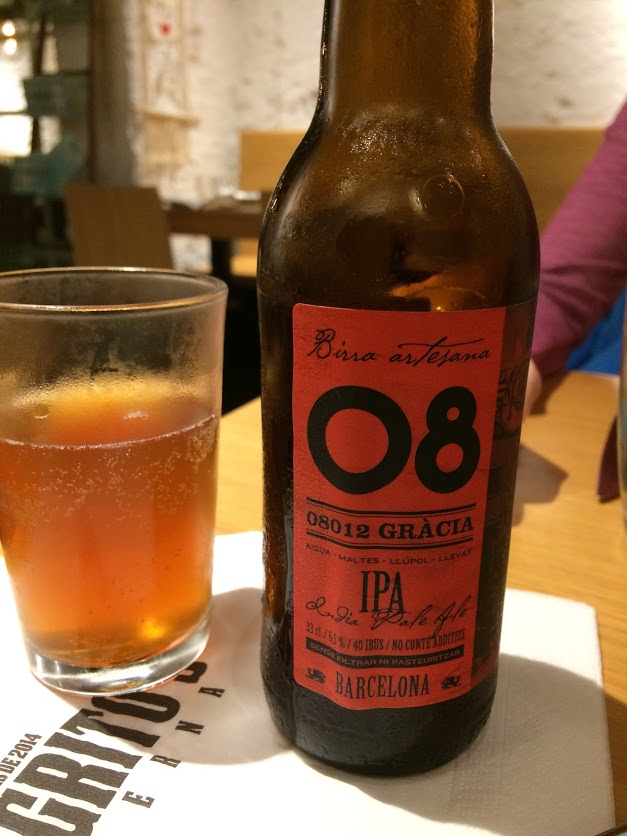
probably the former). The excellent local IPA was a nice surprise.
Our tiny hotel served a generous breakfast,
after which we walked to Placa de Cataluña and got on the Hop on/Hop off bus.
We rode around for a while, getting off at the justly famous Sagrada Familia
church, Gaudi’s architectural masterpiece. We’d been advised to buy tickets in
advance for this popular attraction but of course we hadn’t. Turns out we could
get tickets for that afternoon, so we did.
Back on the bus, we rode around through the city, not really
sure where we wanted to hop off. I wanted to see another Gaudi creation, the
Parc Guell, but we couldn’t find it even though the bus supposedly stopped
there. Turns out the park is a few blocks from the bus stop, which we would
have learned had we but asked the attendant. Missed opportunity for sure!
We hopped off the bus before it completed its circle and
started walking more or less in the direction of Sagrada Familia. We stopped
for lunch at a nice corner café. I looked for the bathroom but the only door I
could find was labeled “Servicia” which I assumed meant a service door (you
know, like for staff or deliveries). So I asked and the nice counter person
pointed to the Servicia door, which did indeed lead to the bathrooms. I really
should have studied that Spanish phrase book more closely.
We walked to the Sagrada Familia after lunch, found the
entrance for ticketed guests, and got in line. A minute before entering, a
nasty storm – wind and rain and lightning – descended. We had brought an
umbrella, so, unlike many hundreds of other visitors, we stayed more or less
dry.The church is spectacular!
The self-guided audio tour, using a very clever little wireless device, was a
bit hard to follow, but it was very informative nonetheless. We learned many
things one would not learn just by wandering around gawking, although the place
is definitely gawk-worthy. The esteemed Mr. Gaudi is buried there and the
construction crews are still at work.
I was struck by the attention to detail in every aspect of
the design. Gaudi was obsessive, sketching every piece of furniture and every
pane in the soaring stained glass windows. The massive tapered columns that
hold up the roof are just one example: Each pair is a slightly different color
of stone and each column gets lighter as it rises; each pair is fluted in a
slightly different way. These subtleties are almost lost in the grandeur of the
whole – we had to look carefully at things right in front of us at the same
time trying to take in the sheer scale of the place.
By the time our visit was over, the storm had passed and the
sun was out!
We decided to get on a different Hop on/Hop off bus route,
but got lost trying to find it. This is one of the downsides of do-it-yourself
travel planning: sometimes you miss stuff, you take a wrong turn, you think
you’re wasting time. But we definitely enjoyed our first day and a half in
Barcelona.
The next day we used up our Hop on/Hop off tickets,
intending to stop and take the cable car from the port up to Montserrat (or was
in Montjuic?). But… cable car not running, too windy. We intended to stop at
the Miro museum (Fundacio Joan Miro), but….too late, not open. We made a long
loop around the city and decided to hop off near the waterfront and walk part
way back to the hotel via La Rambla. This worked except for the fact that
the route was blocked by demonstrators, meaning we couldn’t hop back on where
we wanted to.
But the walk, though longer than planned, was quite
pleasant. We found another pedestrian street just a block or two from La Rambla
that was delightful and took us past the Cathedral of the Holy Cross, where there was a classical music group
giving a concert on the steps.
I do enjoy these serendipitous happenings! And we still made
it back to the hotel in time to pack up, check out, and get a taxi to meet our
traveling companions for the next leg of the trip.
From Barcelona to Pisa, our goal was to have lunch at open-air cafes, preferably a seaside cafe, to sample the local cuisine and the local beverages. The coasts of Spain, France, and Italy are not known for beer, but I figured we'd have plenty of wine at dinner, so lunches were usually accompanied by beer. Some of it was pretty good. Herewith is a travelogue of sorts. There was some spectacular scenery and some quaint old cities and fortresses and castles and palaces and cathedrals. These will be featured another day, perhaps.
For now....the beer!
Portoferraio is the main city on the Italian island of Elba. We visited lots of historic places, including the theater that Napoleon built during his brief stay on Elba. Next to the theater is a nice little bistro called, naturally, Teatro. They bill it as a wine bar, but I had the local ale. It was unexceptional, but the setting is lovely and the food was very good. We enjoyed Portoferraio.
The main city on the Spanish island of Majorca is Palma de Majorca. It is much bigger and busier than we anticipated. We didn't stay long in Palma, instead hopping an old narrow-guage train to the village of Soller. In Soller we were surprised to find an exhibit of Picasso's pottery and some very nice Joan Miro prints. Our lunch of tapas was accompanied by Rosa Blanca beer, described on the label as "hoppy lager." It was very good!
Here's a photo of the square with the restaurant and the big old church.
Menorca, a very small Spanish island, was a lot of fun. We learned that it is famous for its gin and for sandals made from old car tires and cork. We did not buy any gin or sandals, but we did enjoy tapas al fresco, along with a beer call Alhambra. I do not know why it is so named, but I liked it.
The restaurant was on the plaza at the top of these steps. Somebody said there are are 150 steps, but I only counted 115.
And in Nice, France, we had the best dinner of the trip at a place called Zorzetto, where the chef sat down at our table and described the appetizers he had prepared. There were a dozen and we had them all! The first course I had wine, but the second course I asked for beer and the waiter was excited because people in Nice prefer wine but this guy was a beer afficionado. The beer was "Biere du Compte" or The Count's Beer. The waiter's enthusiasm was justified.
In the bathroom at Zorzetto, patrons are greeted by the mascot of the house:
Barcelona is a great place for tapas (in case you hadn't guessed). At a bar across the street from our hotel, we had tapas and the local IPA, which was probably the best beer on the trip.
October 12. It seems like just another ordinary day. It probably is just another ordinary day, even though a few extraordinary things happened on October 12. If one wishes, one can peer into the past and find patterns and connections that seem unusual, even eerie. It's a kind of pointless fun, which is pretty much what this blog is for.
So...
October 12, 1492: Chris Columbus landed in what is now the Bahamas. He thought he had found India or something close to India. He was of course mistaken. Some sources say that the date was really October 13 but Columbus fudged his ship's log because the 13th was considered an unlucky day. Here's a related Brautigan poem, part of a longer series called "Good Luck, Captain Martin."
The BottlePart 3
A child stands motionless.
He holds a bottle in his hands.
There's a ship in the bottle.
He stares at it with eyes
that do not blink.
He wonders where a tiny ship
can sail to if it is held
prisoner in a bottle.
Fifty years from now you will
find out, Captain Martin,
for the sea (large as it is)
is only another bottle.
October 12, 1810: A princess with the musical name Therese von Sachsen Hildburghausen married a Bavarian prince with the prosaic name Louis. The prince soon became King Ludwig I and so Therese became a queen. Their wedding was a big deal in Bavaria and the event was celebrated throughout the land with music and dancing and beer. It was so much fun that the Bavarians decided to do it every year. It became known as Oktoberfest. For this we thank them. Herr Bossnack, my high school German teacher, taught us several drinking songs, including the one seen here. For this I thank him.
October 12, 1892: Exactly 400 years after Columbus began his vacation in the Bahamas, the first rail shipment of iron ore went from Mountain Iron, MN to Duluth. The Duluthians were busy celebrating Oktoberfest (or was it Columbus day?), so the ore sat in piles by the dock for a week before the barely-sober stevedores loaded it onto a big ship headed for Gary, IN.
Iron Ore Betty is the unofficial queen of the Iron Range thanks to this goofy John Prine tune.
October 12, 1960: The United Nations general assembly was meeting in New York. It was a typically cordial (read: boring) meeting until it was Nikita Kruschev's turn to speak. He was agitated about something and began a new rhetorical tradition by removing his shoe and pounding the podium with it. The reasons for his outburst are obscure, but it's likely that he wanted Russian vodka to get equal billing with German beer at the UN after-party.
It's the birthday of Vladimir Putin, born in Leningrad (now known as St. Petersburg), Russia in 1952. Russia was still part of the Union of Soviet Socialist Republics (USSR). Joe Stalin was still general chairman of the Communist Party. Little Vladimir went to technical school in St. Petersburg. He somehow got into the spy business, eventually becoming the head of the intelligence service. He went from there into politics.
I just finished a book by Anne Garrels titled "Putin Country: A Journey into the Real Russia." It confirms some of what we learned when visiting St. Petersburg a few years ago: Russians see Vladimir as a fierce defender of the motherland, yet they complain bitterly of ubiquitous political corruption and the kleptocracy of the powerful at the expense of the average Russian citizen.
Russia, no thanks to Putin, has given the world great literature, great art, and great music. I imagine Mr. Putin going to the Bolshoi Ballet and wishing he were somewhere else.
Putin should not be confused with poutine, although both are distasteful in their own way.
Today is the birthday (1951) of Dave Winfield. He was born in St. Paul and grew up there. He went to the University of Minnesota and was a star in several sports. Indeed, professional teams in basketball, football, and baseball drafted Winfield. He chose baseball, was converted from a pitcher to a power-hitting outfielder, and became a star. He spent 22 seasons in the majors, was an all-star every year from 1977 to 1988, and made the Hall of Fame in 2001.
Some interesting things about big Dave:
In 1983, Winfield was playing for the Yankees when, during pregame
warmups in Toronto, he threw a ball that hit and killed a seagull.
Canadian authorities briefly considered charging him with animal
cruelty.
Winfield spent one season (1992) in Toronto, where he helped the blue Jays win their first World Series. They traded him during that off-season.
The irascible George Steinbrenner, owner of the Yankees, was so frustrated by Winfield's lack of production in the playoffs that he dubbed Winfield "Mr. May."
When he was inducted into the Hall of Fame, Winfield gave one of the longest and most boring speeches ever. I know, because Michael and I were there. Kirby Puckett and Bill Mazeroski were inducted that year, too, and their speeches were much better.
We saw Winfield some years later in the Los Angeles Airport. He was heading back to Minnesota to attend the memorial service for Kirby Puckett.
And then there's Jack Morris.
Jack Morris was also born in St. Paul and also played on the 1992 Toronto Blue Jays championship team (he pitched in three playoff games and lost all three). Morris had pitched that amazing Game 7 -- a complete-game shutout -- for the Twins the year before. Winfield made the Hall of Fame on his first year of eligibility; Morris was on the ballot for 15 years before finally getting the votes.
Morris works as a commentator on some Twins TV broadcasts and he is the quintessential grumpy old man. Nothing about the modern game suits him -- he doesn't like advanced stats, the defensive shift, the use of replays, long pants, or bat flips. I can barely stand to listen to him whine.
And don't forget Paul Molitor.
Molitor grew up in St. Paul and had a brilliant 21-year career, mostly with the Brewers. Like Morris and Winfield, he played for the Twins briefly and with Toronto (he was the Blue Jays MVP in 1993 when they repeated as World Series champs). He finished his career as Minnesota's manager but was summarily dismissed after last year's crummy showing.
 From the port of Mahon (sometimes spelled Mao) we took a drive around the island. First stop, the tiny resort town of Fornell (pronounced FourNAY).